

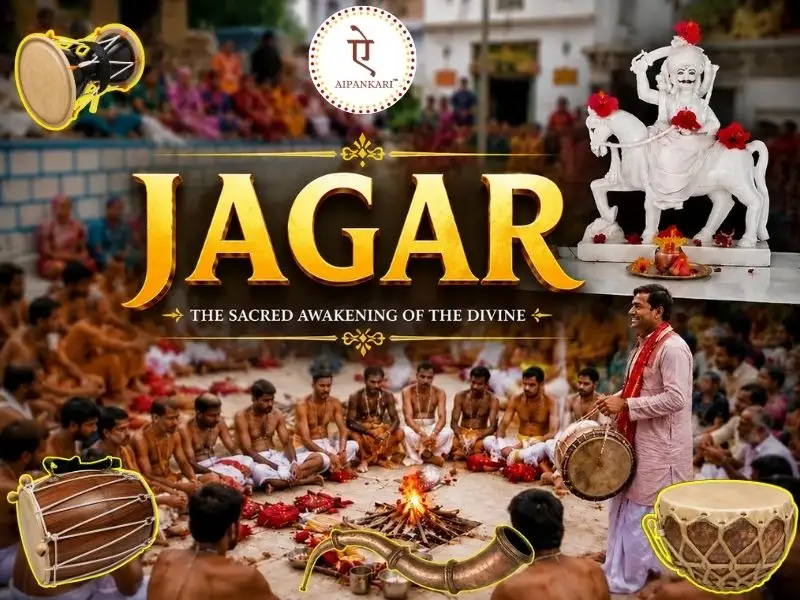
What is the Meaning of Jagar? — The Most Sacred Call of Devbhoomi
Uttarakhand is called Devbhoomi — and this title was not given lightly. For centuries, the presence of divine beings has been felt in every mountain here, in the gentle flow of every river, in the rustling of dense forests, and in every corner of every village. When clouds collide with the peaks of the Himalayas, it feels as though the gods are speaking. Among the most vibrant, most mysterious, and most spiritual traditions of this Devbhoomi is — Jagar.
Jagar means awakening — the awakening of divine forces, local deities, and ancestral spirits that are believed to reside in this sacred land. The word “Jagar” is derived from the Hindi-Sanskrit root “jaag,” which means to wake up, to be awakened. When a village faces a crisis, when there is illness or conflict in a home, when crops fail, when livestock falls sick, or when someone holds a deep heartfelt wish — a Jagar is organized. It is considered the most direct, most profound, and most ancient form of communication between the divine and the human.
Jagar is not merely a religious ritual — it is the living expression of Uttarakhand’s folk culture. It holds faith, music, folk literature, tales of valor, spiritual energy, and a deep emotion that gives the listener goosebumps. On the night of Jagar, when the beats of the hudka and dhol-damaun resonate, when divine tales pour forth in the voice of the Jagariya, and when the deity descends into the body of the Dangariya — that moment is nearly impossible to describe in words. It can only be known by living it.
In the folk culture of Uttarakhand, Jagar is considered an extremely sacred and divine tradition — a tradition where direct communication between the gods and humans is believed to take place.
Uttarakhand Jagar — The Shared Cultural Heritage of Kumaon and Garhwal
Uttarakhand Jagar is not a uniform tradition — it is the confluence of two great cultural streams. Uttarakhand is broadly divided into two cultural regions — Kumaon and Garhwal. Each of these regions has its own style of Jagar, its own language, and its own local deities. The roots are the same, but the branches spread in different directions.
Kumaoni Jagar — The Beat of the Hudka and the Call of the Mountains
Kumaoni Jagar is prevalent in the Kumaon division of Uttarakhand — Almora, Nainital, Pithoragarh, Champawat, Bageshwar, and Udham Singh Nagar. Its language is the Kumaoni folk dialect, known for its sweetness, depth, and emotional richness.
In Kumaoni Jagar, the beat of the hudka holds the most prominent place. The hudka is a small drum-like instrument played from both sides. Its rhythm has a strange magnetic quality — a pull that binds the listener completely. In Kumaoni Jagar, deities such as Golu Devata, Harjyu, Gangnath, the deities of the Katyuri tradition, and Nanda Devi are especially invoked.
In Kumaoni Jagar, along with episodes from the Ramayana and Mahabharata, folk tales of local heroes and deities are sung. These narratives are so vast and so captivating that the entire night passes without anyone realizing it.
Garhwali Jagar — The Roar of the Dhol and the Blessings of the Himalayas
Garhwali Jagar is prevalent in the Garhwal division of Uttarakhand — Dehradun, Haridwar, Pauri, Tehri, Rudraprayag, Uttarkashi, and Chamoli. Its language is Garhwali, which carries its own distinct musicality and folk character.
In Garhwali Jagar, the dhol and damaun hold prominence. The deep, thunderous sound of the dhol pierces the silence of the night and reaches the sky. This sound is not merely an instrument — it is a call summoning the gods. In Garhwali Jagar too, episodes from the Ramayana and Mahabharata, tales of local deities, and folk stories are sung, but their style and rhythm are distinctly colored in the Garhwali tradition.
In both traditions, the core purpose of Jagar is the same — to invoke the deity, to establish communication with them, and to receive their guidance, blessings, and solutions to problems. This is the thread that binds the two great cultural streams of Uttarakhand together.
The Three Primary Forms of Jagar — One Tradition, Three Expressions
Jagar does not take place in just one way. Over centuries of evolution and based on local traditions, three primary forms of Jagar have developed. Each form has its own identity, its own music, and its own spiritual depth.

1. Hudkiya Jagar — A Harmony of Sweetness and Rhythm
In Hudkiya Jagar, the hudka is the main instrument. The hudka is a small, hand-played drum-like instrument covered with leather on both sides. The beat of the hudka can be sweet, sharp, and rhythmic all at once. The Jagariya invokes the deities while playing the hudka. This is the most common, most popular, and most widespread form of Jagar. In most areas of Kumaon, Hudkiya Jagar is the predominant form.
The beat of the hudka carries a kind of hypnotic quality — as the rhythm intensifies, spiritual energy begins to fill the atmosphere and the process of the deity’s descent begins.
2. Damariya Jagar — The Sacred Form of Quiet Devotion
In Damariya Jagar, a plate (thali) and the damru are used. This is a calmer, more meditative, and more intense form of Jagar. The tinkling of the thali and the sharp sound of the damru together create a special spiritual atmosphere. The damru is considered dear to Lord Shiva, and its sound is believed to carry cosmic energy.
In Damariya Jagar, the descent of the deity into the Dangariya is deeper and more intense. This form is performed especially on occasions where a particularly deep invocation of divine power is necessary.
3. Dhol Jagar — The Experience of Thunder and Power
In Dhol Jagar, the dhol and nagada are the primary instruments. The deep, heavy, and thunderous sound of the dhol shakes the entire atmosphere. This sound awakens every pore of the body. Combined with the loud and sharp beat of the nagada, the sound of the dhol creates music that makes the descent of the deity even deeper and more powerful.
In Dhol Jagar, the atmosphere is the most energetic and thrilling of all. When the Dangariya dances to the beat of the dhol-nagada and the expressions of the deity manifest — the sight simultaneously evokes reverence and excitement in the hearts of all present.
The Four Key Figures of the Jagar Ritual — The Four Pillars of Divine Communication
Jagar cannot be performed by a single individual — it is a collective, social, and spiritual process in which many people play their role. Four main types of people are involved in conducting the Jagar ritual. In addition to these, family members, villagers, and devotees gather as witnesses to receive the deity’s blessings.
Jagariya — The Soul of Jagar
The Jagariya is the main singer and conductor of the Jagar. He is the central figure of the entire ritual. Using folk language, devotional songs, mantras, and traditional musical instruments, the Jagariya invokes the goddesses and gods. He creates a spiritual atmosphere by describing the deity’s biography, heroic tales, powers, and virtues in great detail — an atmosphere from which the Jagar process begins and progresses.
The Jagariya possesses an extremely deep and extensive knowledge of folk traditions, religious stories, and divine narratives. He memorizes the tales from the Ramayana, Mahabharata, and local folk deities and presents them in an emotionally resonant and powerful manner. A good Jagariya is not only a singer — he is also a spiritual guide, a storyteller, and a messenger of the divine. Becoming a Jagariya is a form of devotion, a responsibility, and a sacred service.
Dangariya — The Bridge Between the Divine and the Human
The Dangariya is the human medium into whom the deity is believed to descend during Jagar. This is the most mysterious and most supernatural aspect of Jagar. It is believed that the deity enters the body of the Dangariya and reveals to those present the solutions, causes, and answers to their problems and sufferings.
During the deity’s descent, the Dangariya manifests divine speech with special expressions and energy. His eyes change, his language and voice transform, and his body dances and trembles in a particular way. Devotees consider this completely sacred, and every word spoken by the Dangariya during this time is regarded as divine utterance.
Becoming a Dangariya is also no ordinary matter. It is the result of a special spiritual capacity and prolonged devotion. The Dangariya must live according to strict rules, purity, and discipline.
Syonkar and Syonnai — The Organizers and Seekers of Jagar
The Syonkar and Syonnai are the organizers of the Jagar. Generally, it is the family or individual who wishes to invoke the deity — due to some problem, crisis, heartfelt wish, or religious reason — who organizes the Jagar.
The Syonkar (male) and Syonnai (female) present their problems and questions before the deity during Jagar. They are the hosts who bear all the expenses of the Jagar, arrange the community feast, and make all preparations for the ritual. Their faith and belief are the very foundation of the Jagar.
Gaaje-Baaje Vaale — The Path to the Divine Through Music
The Gaaje-Baaje Vaale perform the important function of music and instrumental playing in Jagar. The beats of traditional instruments such as the dhol, damaun, hudka, nagada, and damru make the spiritual atmosphere of Jagar even more powerful, energetic, and mysterious.
These musicians are not merely instrument players — they are the ones who regulate the energy of the Jagar. When the Jagariya sings and the deity is descending into the Dangariya, it is the beat of the Gaaje-Baaje Vaale that deepens that divine energy further. Without them, Jagar is considered not just incomplete — but impossible.
The Sacred Fire Pit (Dhooni) and Purity — Where the Earth Becomes a Divine Seat
In the Jagar ritual, the dhooni is not merely a place where fire is lit. It is the sacred center of faith, energy, folk art, and spiritual power — the place where the deities descend. In the folk tradition of Uttarakhand, the dhooni is considered the seat of the gods and a symbol of divine presence. The entire process of Jagar is conducted around this sacred dhooni, which is why its purity, decoration, and preparation hold special importance.

Preparation of the Dhooni — A Sacred Process
Before preparing the dhooni, the place is purified by plastering it with cow dung and red clay (geru). This plastering is not merely a cleaning — it is the process of elevating that space beyond the mundane and moving it toward the divine. Cow dung is considered extremely sacred in Hindu tradition, and red geru clay symbolizes auspiciousness and power.
After this, fine geometric patterns, vertical lines, and auspicious symbols are drawn using a rice paste — locally called biswar — in the art form known as Aipan. Aipan is the ancient folk art of Uttarakhand, made on special occasions at homes, temples, and sacred places. These white Aipan lines transform ordinary ground into a divine and spiritual form, establishing the dhooni as a true “seat of the gods.”
Lighting the Dhooni and the Rules of Purity
The decorated dhooni is lit by the Syonkar with the sound of a conch shell and the chanting of mantras. The sound of the conch dispels negative energies from the atmosphere and sends an invitation to the gods.
During Jagar, the rules of purity around the dhooni are extremely strict. Entering while wearing footwear is completely forbidden. Special care is also given to maintaining mental and spiritual purity in the atmosphere. Negative thoughts, lies, anger, and impurity are considered prohibited here.
Purification of the Dangariya — The Importance of Panchagavya
It is believed that before the deity descends, the Dangariya purifies himself by consuming Panchagavya — cow urine, Ganga water, milk, curd, and ghee. These five elements are considered the most sacred in Hindu tradition. Only after this purification does he enter the dhooni and accept the invocation of the deity.
Amid the sound of the dhol, damaun, and hudka, the flames and smoke rising from the dhooni fill the entire atmosphere with a mysterious, devotional, and divine energy. In that moment, every person present feels as though they have been transported somewhere beyond the ordinary world — a place where the distance between the divine and the human disappears.
The Seven Sacred Stages of Jagar — A Divine Journey from Night to Dawn
The Jagar ritual is a well-structured and profound spiritual process. It is not a disorganized event — every stage has its own significance, its own purpose, and its own spiritual meaning. Traditionally, Jagar is divided into seven main stages. These seven stages represent a remarkable divine journey from the beginning of the night to the break of dawn.
Stage 1 — Saanjhvaali: The Evening Invocation, from Earth to Sky
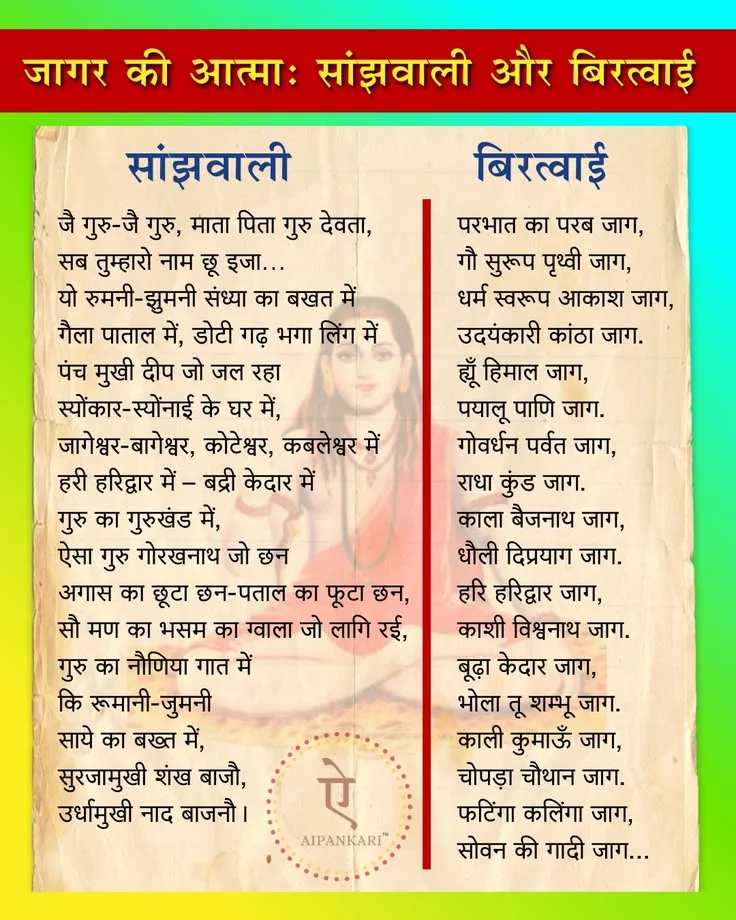
Jagar begins with Saanjhvaali. This is the most important moment of the twilight — the junction between day and night. In this stage, the Jagariya sings an evening prayer while invoking the goddesses and gods of all three worlds — the earth, the sky, and the underworld.
In Saanjhvaali, the Jagariya calls upon the deities from every corner of the universe, from every direction, from the mountains, the rivers, the forests, and the sky. This is the prelude to the Jagar — purifying and calming the atmosphere, dispelling negative forces, and preparing the path for the arrival of divine energy. Special folk tunes and mantras are used that have been sung for thousands of years for exactly this purpose.
Stage 2 — Biratvaai: The Singing of Heroic Tales, the Memory of Valor
After Saanjhvaali comes the stage of Biratvaai. This word is derived from “birudaavali” — meaning a composition of heroic praise, a description of bravery. In this stage, the Jagariya sings the birudaavali of the particular deity being invited in the Jagar — describing the deity’s courage, their power, the significant events of their life, their struggles, and their victories in great detail.
In Biratvaai, the beats of the dhol, damaun, and hudka gradually begin to intensify. What began with calm now starts filling with energy. The emotion and intensity in the Jagariya’s voice increases, spiritual energy begins to flow through the entire atmosphere, and a tide of devotion rises in the hearts of the devotees present.
Stage 3 — Ausaan: The Thrilling Moment of the Deity’s Arrival
Ausaan is the most thrilling and most supernatural stage of Jagar. At this point, both the speed and pitch of the instruments become extremely intense. The beats of the dhol, damaun, and hudka grow continuously louder. The Jagariya’s singing reaches its peak.
Under the influence of this intense music and mantras, the body of the Dangariya begins to tremble. He begins to enter special expressions and the body shows an otherworldly dance and vibration. This is considered a sign of the deity’s descent. Reverence, awe, and excitement rise simultaneously in the hearts of the devotees present. A wondrous mystery envelops the atmosphere — as though something extraordinary is about to happen.
Stage 4 — Guru Aarti: Paying Homage to the Guru, Honoring Tradition
After the deity has descended, the Guru Aarti is performed first. This is an extremely important stage. It is believed that upon descending, the deity first remembers his Guru — especially Gorakshanath, who is revered as the great Guru of the Nath Sampraday in the folk tradition of Uttarakhand.
Guru Aarti is a symbol of respect for the Guru tradition and spiritual power. It is a reflection of that great Indian tradition where every act is preceded by a bow to the Guru — because without the Guru, no knowledge or power is complete.
Stage 5 — Khaak Ramaana: The Divine Touch of the Sacred Ash from the Dhooni
In this stage, the descended deity blesses the devotees by applying the sacred ash from the dhooni — known as vibhuti — to them. This is called Khaak Ramaana.
Vibhuti is one of the most sacred substances in Hindu tradition. It is the symbol of Lord Shiva, and applying it is believed to bring divine grace and protection. Devotees consider this vibhuti a sacred protective shield. The ash applied by the hands of the deity is priceless to them.
Stage 6 — Daani Ka Vichaar: Diagnosis of Problems, Divine Solutions
This is the most central and most important stage of Jagar — and the very reason the Jagar is organized — Daani Ka Vichaar. In this stage, the descended deity takes rice — locally called daani — in their hand and examines the problem, suffering, or crisis of the host (Syonkar).
Through the daani, the deity sees and understands everything that is beyond the comprehension of ordinary humans. After this, they provide solutions, guidance, and blessings. They reveal the cause of the problem, what its remedy will be, which deity needs to be worshipped, which fast must be observed, or what other measures need to be taken. The host receives this divine speech with complete devotion.
Stage 7 — Aashirvaad and Vidaai: The Deity’s Departure, Peace in the Heart
In the final and seventh stage of Jagar, the descended deity blesses all the devotees present with happiness, prosperity, good health, and freedom from suffering. After this blessing, the Dangariya signals the deity’s departure through special dance movements and expressions.
It is believed that the deity returns to their abode — Kailash or Devaloka. As the deity departs, the body of the Dangariya begins to return to its normal state. The speed of the instruments slows, and a deep sense of peace and fulfillment settles over the atmosphere. The Jagar ritual is complete.
The Principal Village Deities and Folk Deities of Jagar — Protectors of the Village, Givers of Justice
In the Jagar tradition of Uttarakhand, village deities and folk deities hold the greatest significance. These deities do not reside in temples or books, but in this soil, this air, and this water. They are considered the protectors of villages, families, livestock, nature, and human life. Through Jagar, these deities are invoked and prayers are offered to them for protection, justice, health, prosperity, and freedom from hardships.

Bhumiya Devata — Guardian of the Earth
Bhumiya Devata is considered the protector of the village, fields, and land. In every village of Uttarakhand, Bhumiya Devata has a place — often beneath a large stone or tree. In rural areas, he is believed to protect against natural disasters, diseases, and negative forces. In Jagar, Bhumiya Devata is invoked especially for the protection of land and family, for good harvests, and for the prosperity of the village.
Golu Devata — The Eternal Deity of Truth and Justice
Golu Devata is one of the most famous, most beloved, and most justice-loving folk deities of Kumaon. He is called the “God of Justice.” According to popular belief, anyone who sincerely seeks justice from Golu Devata will surely receive it.

Devotees present their problems and prayers for justice to Golu Devata in the form of letters — yes, actual written letters. This tradition is unique in the world. Chitai Temple (Almora), Ghorakhal Temple (Nainital), and Gorikalchaud Temple are the main centers of devotion for Golu Devata. In Jagar, the invocation of Golu Devata is done for justice, problem resolution, and freedom from the obstacles of enemies.
Gangnath Devata — The Immortal Tale of Valor and Sacrifice
Gangnath Devata is believed to be the son of a prince from the Doti region, who later attained the status of a folk deity due to his valor, loyalty, and sacrifice. His folk tales are full of bravery, love, and sacrifice — tales that move the listener to tears. In many regions of Uttarakhand, the Jagar of Gangnath is performed with deep reverence. The singing of his Jagar is deeply emotional and touching.
Harjyu Devata — Protector of Family and Village
Harjyu Devata is considered the protector of the clan and the village. According to popular belief, he shields his devotees from crises, fear, and negative forces and maintains peace and happiness within the family. When a family faces a great calamity or recurring problems, the Jagar of Harjyu Devata is considered especially important.
Narsimha Devata — Protector of Dharma, Destroyer of Injustice
Narsimha Devata is considered the fierce and powerful avatar of Lord Vishnu. In Jagar, he is revered as the symbol of the protection of righteousness, the destruction of injustice, and the annihilation of evil forces. His Jagar carries a special sense of power and energy. When Narsimha Devata is invoked, the sound of the dhol-damaun and the singing of the Jagariya reach an entirely different height.
Kail Bisht — The Protective Deity Who Plays the Flute
Kail Bisht is known as a protective folk deity who plays the flute. In folk tales, he is deeply connected to nature, livestock, and rural life. He is the deity of mountain pastures, forests, and the world of animals. The songs of his Jagar are extremely melodious and rich in folk tunes — a sweetness that touches the heart of the listener.
Chomu Devata — Protector of Livestock
Chomu Devata is considered the protector of animals and animal keepers. Uttarakhand is a mountainous region where livestock is the economic backbone of the family. Therefore, Chomu Devata holds special significance in rural society. The Jagar of Chomu Devata is performed during times of livestock illness, loss, or crisis.
Nanda Devi — The Presiding Goddess of the Himalayas, the Form of Shakti
Nanda Devi is the most prominent folk goddess and manifestation of Shakti in both Kumaon and Garhwal. She is called the presiding deity of the Himalayas — the mistress of the Himalayas. The Nanda Devi Rajjaat Yatra — which takes place once every twelve years — is considered the greatest and most important religious journey of Uttarakhand. The Jagar associated with Nanda Devi is an extremely important and deeply emotional part of the culture and faith of Uttarakhand.
Saim Devata — Deity of Strength and Discipline
Saim Devata is revered as the folk deity of village protection, strength, and discipline. It is believed that he protects the village from negative forces, the evil eye, and dangers. His Jagar carries a unique experience of energy and radiance.
Aidi Devata — Guardian of Boundaries and Forests
Aidi Devata is considered the guardian of the village’s boundaries, forests, and natural areas. Villagers remember him before setting out on a journey, before starting work in the fields, and before entering the forest.
Laatu Devata — The Deity of Mystery and Asceticism
Laatu Devata is considered the deity of mystery, rigorous asceticism, and discipline. In Uttarakhand, many mysterious beliefs are associated with his temples and traditions. One special belief is that Laatu Devata is considered the spiritual brother of Nanda Devi — meaning there is a sacred sibling bond between them.
Kalika Mata — Goddess of Power, Courage, and Protection
Kalika Mata is venerated as the goddess of power, courage, and protection. In Jagar, she is invoked for the destruction of negative forces, freedom from evil spirits, and the protection of devotees. Her Jagar carries a distinct experience of radiance and power.
The 52 Veer of Mata — Embodiments of Shakti
The 52 Veer of Mata are considered symbols of power, courage, protection, and divine energy. In folk beliefs and the Jagar tradition, these warriors are worshipped as the divine army of the Mother Goddess, who protect devotees, destroy crises, and uphold righteousness. Each Veer has his own distinct form, role, and spiritual significance. Some are the protectors of villages and temples, while others symbolize tantric powers, knowledge, martial skill, and the safety of devotees. In the folk culture of Uttarakhand, the 52 Veer of Mata are considered the living form of faith, valor, and invisible divine power.
- Kshetrapal Veer – Protector of places and temples.
- Kapil Veer – Symbol of knowledge and asceticism.
- Batuk Veer – Protector in the form of a child.
- Nrisimha Veer – The fierce Veer who destroys evil.
- Gopal Veer – Protector of cows and devotees.
- Bhairav Veer – Considered the chief protector of the Mother Goddess.
- Garudh Veer – Protection from serpents and negative forces.
- Mahakaal Veer – Symbol of control over time and death.
- Kaal Veer – Remover of crisis and fear.
- Swarn Veer – Giver of wealth and prosperity.
- Raktaswarn Veer – Symbol of strength and courage.
- Devsen Veer – The leading warrior of the goddess’s army.
- Ghantapath Veer – Guardian of the path.
- Rudra Veer – Veer associated with the fierce form of Shiva.
- Terasangh Veer – Symbol of collective protection.
- Varun Veer – Guardian of the water element.
- Gandharva Veer – Associated with music and divine powers.
- Hans Veer – Symbol of purity and knowledge.
- Launkadiya Veer – The Veer who provides secret protection.
- Vahi Veer – Symbol of message and speed.
- Priyamitra Veer – Helper of devotees.
- Karu Veer – One who accomplishes tasks.
- Adrishya Veer – Protector in invisible form.
- Vallabh Veer – Giver of love and grace.
- Vajra Veer – Extremely powerful and formidable Veer.
- Mahakali Veer – Associated with the power of Mata Kali.
- Mahalabh Veer – Giver of benefit and success.
- Tungabhadra Veer – Symbol of strength and stability.
- Vidyadhar Veer – Giver of knowledge and intellect.
- Ghantakarn Veer – Protection from negative forces.
- Baidyanath Veer – Protector from diseases.
- Vibhishan Veer – Supporter of righteousness and truth.
- Faahetak Veer – Veer who destroys crises.
- Pitr Veer – Associated with the protection and grace of ancestors.
- Khadga Veer – The warrior who bears the sword.
- Naaghasht Veer – Veer with mysterious powers.
- Pradumn Veer – Symbol of courage and martial skill.
- Shmashan Veer – Tantric power and dispeller of fear.
- Bharudg Veer – Symbol of protection and valor.
- Kaakelekar Veer – Veer associated with secret sadhana.
- Kanfilabh Veer – One who fulfills wishes.
- Asthimukh Veer – Of fierce and formidable appearance.
- Retovedy Veer – Symbol of esoteric knowledge.
- Nakul Veer – Symbol of agility and protection.
- Shaunak Veer – Associated with the power of the sage.
- Kaalmukh Veer – Destroyer of evil forces.
- Bhutbhairav Veer – Protection from ghosts and spirits.
- Paishaach Veer – Controller of negative forces.
- Trimukh Veer – The powerful three-faced Veer.
- Dachak Veer – Associated with battle and protection.
- Attaalaad Veer – Symbol of unwavering strength and courage.
- Vaasmitra Veer – The Veer who protects in a friendly manner.
Katyuri Jagar — A Living Document of History and Culture
Katyuri Jagar is the historical and sacred Jagar tradition of the ancient and glorious Katyur dynasty of Uttarakhand. The Katyuri dynasty was a great royal lineage that ruled this region for centuries. In this Jagar, the valor, courage, sacrifices, and folk tales of the Katyuri kings are sung in great detail.
Katyuri Jagar is not merely a religious ritual — it is an important medium for keeping alive the history, valor, and cultural heritage of Uttarakhand. Listening to this Jagar offers a glimpse of Uttarakhand’s past — a past filled with bravery, sacrifice, and glory.
Baisi — The Most Rigorous, Most Intense, and Most Mysterious Practice of Jagar
In the Kumaon region of Uttarakhand, an extremely sacred and austere ritual associated with the devotion of folk deities and the Jagar tradition is called “Baisi.” Baisi is not merely a religious event — it is that profound form of penance, discipline, faith, and spiritual power that tests the limits of ordinary human beings.
Duration of Baisi — Three Forms of Penance
According to popular belief, the duration of devotional penance for deities can vary. These are known in three primary forms:
Chhamasi — 6 months of sadhana Trimaasi — 3 months of sadhana Baisi — 22 days of sadhana (most widely practiced)
Baisi is generally a rigorous practice lasting 22 days. However, in circumstances such as sutak (impurity arising from death) or naatak (impurity arising from birth), it can also be completed in 11 days or 18 days.
Tapasi Dangariye — Devotees Bound by Strict Rules
The practitioners who participate in Baisi are called “Tapasi Dangariye” or Bhagat. During Baisi, these practitioners completely withdraw from their family and worldly life and reside at the temple or divine site. They wear saffron-colored garments — gerua vastra — which are symbolic of renunciation and spirituality.
During Baisi, these practitioners must follow extremely strict rules:
Bathing three times daily — purification of the body Vow of silence — purification of speech Sattvic diet — purification of food Mental purity — purification of the mind Distance from worldly pleasures and relationships
The Daily Ritual of Baisi
During Baisi, Jagar is organized every night. Through dhol, damaun, hudka, and folk singing, the gods and goddesses are invoked. As the days pass and the practice progresses, the experience of spiritual energy and mysteriousness in the atmosphere grows deeper. The villagers stay awake through the night and participate in this great spiritual ceremony.
The 11th Day — The Terrifying and Supernatural Moment of the Fire Trial
The 11th day of Baisi is considered extremely important and thrilling. On this day, the Dangariya must undergo a severe fire trial to prove the authenticity of the deity’s descent.
According to folk tradition, licking or touching a red-hot iron rod heated in the dhooni is considered a symbol of the presence of divine power. This test is impossible for any ordinary human being — but when divine power descends, that which seems impossible becomes possible. Devotees consider this direct evidence of divine grace and supernatural power. This sight deepens the faith of all those who witness it.
Syaurat — The Most Mysterious Night of Baisi
The final night of Baisi is called “Syaurat.” This is the most mysterious, most powerful, and most grand stage of the entire Baisi ritual.
On this night, a special procession is taken out with 22 burning torches — all the way to the boundaries of the village. This procession is not merely a religious circumambulation — it is an ancient ritual for the protection of the village. During this procession, “kilong” — that is, sacred stakes — are driven into the ground at various important locations.
It is believed that these kilong create an invisible protective shield on the village boundaries, protecting the village from negative forces, diseases, evil spirits, and inauspicious influences. This procession carried through the darkness of the night in the light of 22 torches is an extremely thrilling and spiritual sight.
The Conclusion of Baisi — The Glory of the Mahabhondara
Finally, on the 22nd day — the last day of the practice — a grand community feast known as Mahabhondara is organized along with worship and the deity’s blessings. All the people of the village and devotees arriving from neighboring villages come together to partake in this prasad. This Mahabhondara is a symbol of community spirit, love, and faith.
The Baisi tradition is still considered the most living and powerful symbol of folk faith, divine culture, and ancient spiritual heritage in Uttarakhand.
Preserving Jagar — A Responsibility That Belongs to All of Us
Jagar is not merely a folk tradition of Uttarakhand — it is the soul of this land. It holds faith, spirituality, folk music, history, and the reflection of the emotions of millions of people who have lived this tradition for centuries. Preserving this sacred heritage of centuries is a collective responsibility of all of us — especially every son and daughter of Uttarakhand.
In modern times, Jagar is gaining popularity. Millions of people watch Jagar videos on YouTube, share them on social media, and its performances are held on stage. All of this is good — because it is increasing the reach of Jagar. But along with this, it is equally important that the true form, dignity, and procedures of Jagar be understood and preserved.
Viewing Jagar merely as entertainment, a stage performance, or folk music diminishes its spiritual dignity. It is a practice of devotion, a matter of faith, and a sacred process of divine invocation. The importance of purity, discipline, and folk faith within it cannot be fully conveyed on any stage.
What is Essential for the Preservation of Jagar
Jagar should be viewed not as entertainment, but as a devotional practice and an expression of folk faith. Traditional rules, restraint, purity, and rituals should be followed with respect. In stage performances and modern media, the sanctity and sensitivity of Jagar must be maintained. Jagariyas, Dangariyas, and traditional artists should receive proper respect, encouragement, and financial support. The younger generation should be correctly informed about the true meaning, history, and cultural significance of Jagar. The folk songs, divine narratives, and traditions associated with Jagar should also be preserved in written form.
Today’s younger generation can play the most important role in preserving this tradition. If young people are properly introduced to the history of Jagar, its folk deities, rituals, and its spiritual depth, they can become powerful carriers of this priceless heritage. Correct information should be spread through social media and digital platforms — but the original form and sanctity of Jagar should never be compromised.
Jagar is not only the identity of Uttarakhand — it is the cultural soul of who we are. Passing it on to future generations is our most sacred duty.
Aipankari and the Preservation of Uttarakhand’s Folk Culture
Aipankari is not merely a brand, but an effort to preserve and carry forward the folk art, spiritual traditions, and cultural heritage of Uttarakhand. Creations inspired by Jagar, Aipan art, folk deities, and mountain culture work to bring Uttarakhand’s ancient identity to modern generations.
The aim of Aipankari is not only to showcase traditional art, but also to carry the faith, history, and emotions hidden behind it to the people. Through this medium, the folk culture of Uttarakhand is being presented to the world in a new form — so that future generations remain connected to their roots, traditions, and the cultural heritage of Devbhoomi.
Frequently Asked Questions — FAQ
Question 1: What is Jagar and what does it mean?
Jagar is an ancient sacred nighttime ritual tradition of Uttarakhand. The word “Jagar” is derived from “jaag,” which means awakening. In it, the Jagariya invokes the gods and goddesses to the beat of dhol-damaun and hudka, the deity descends into the body of the Dangariya, and the problems of the devotees are resolved.
Question 2: What is the difference between Kumaoni Jagar and Garhwali Jagar?
The purpose of both is the same — invocation of the deity — but the language, tunes, and folk deities differ. In Kumaoni Jagar, the hudka is the primary instrument and deities such as Golu Devata and Harjyu are invoked. In Garhwali Jagar, the dhol-damaun predominates and singing is performed in the Garhwali folk language.
Question 3: Who is the Dangariya?
The Dangariya is the human medium into whom the deity is believed to descend during Jagar. Through him, the deity observes the problems of the devotees and provides solutions. To become a Dangariya, special spiritual capacity and strict observance of rules is required.
Question 4: What are the seven stages of Jagar?
The seven main stages of Jagar are — Saanjhvaali (evening prayer), Biratvaai (singing of heroic tales), Ausaan (signal of the deity’s descent), Guru Aarti (paying homage to the Guru), Khaak Ramaana (blessing with sacred ash), Daani Ka Vichaar (solution of problems), and Aashirvaad and Vidaai (the deity’s departure).
Question 5: What is Baisi and how many days does it last?
Baisi is a rigorous 22-day spiritual practice associated with the Jagar tradition. In circumstances of sutak or naatak, it can also be completed in 11 or 18 days. During it, practitioners wear saffron-colored garments and reside at the temple, bathe three times daily, and Jagar is organized every night.
Question 6: What is the significance of the Syaurat night of Baisi?
Syaurat is the final and most mysterious night of Baisi. On this night, a procession is taken out with 22 burning torches to the boundaries of the village, and sacred kilong (stakes) are driven into the ground at various locations. This is believed to protect the village from negative forces.
Question 7: Which musical instruments are played in Jagar?
In Jagar, the primary instruments played are the dhol, damaun, hudka, nagada, and damru. Without these, Jagar is considered incomplete.
Question 8: What is the significance of the dhooni in Jagar?
The dhooni is the sacred center of Jagar, considered the seat of the gods. It is prepared by plastering with cow dung and red clay (geru) and making Aipan patterns with biswar (rice paste). The dhooni is lit with the sound of the conch shell, and entering near it while wearing footwear is forbidden.
Question 9: Why is the Jagar of Golu Devata famous?
Golu Devata is the deity of justice in Kumaon. His Jagar is performed especially for obtaining justice, resolving problems, and gaining freedom from the obstacles of enemies. People also convey their problems to him by writing letters — this tradition is unparalleled.
Question 10: Has Jagar received UNESCO recognition?
Jagar is the priceless intangible cultural heritage of Uttarakhand and efforts are being made at various levels for its preservation. The folk traditions of Uttarakhand have been included in the Indian cultural heritage list.
This article has been presented by Aipankari with the aim of preserving and promoting the folk culture, Jagar tradition, and spiritual heritage of the mountains of Uttarakhand. Our effort is to ensure that this invaluable treasure of Devbhoomi reaches future generations in its true form.
Nice and excellent.very best information introduced.
Appricisiated..Kindly procure this kind of holi advice and information respectively.Now I am proudly say JAI DEVBHUMI.Highly obliged and warm. Jay Guru Gorakhnath.Now at lost Pranam / Namask,ar/pailag
Understood properly.
Warm regarfs
Can you please tell me your sources for such detailed research…
Thank you for asking. 🙏 Along with published sources and research material, we also gathered information through conversations with local people and elders in Uttarakhand. Since Jagar is largely an oral and regional tradition, local knowledge and lived experiences were important in understanding the tradition and documenting its different practices.
Hello 🙏🌸
Very exciting article..I like to learn more about this subject, i feel a deep urge to arrange some cultural trips to india that gives people knowledge about this cultural tradition…Can you bring me in contact with some of these jagars?..
Kind regards Beatrix Nielsen
Thank you so much for your beautiful and inspiring message.
The famous Nanda Devi Raj Jaat Yatra of Uttarakhand is an important religious and cultural tradition, traditionally held once every 12 years. This time, due to Malmas (Adhik Maas / an additional lunar month), the main Nanda Devi Raj Jaat Yatra has been postponed until 2027.
However, in 2026, the Nanda Devi Lok Jaat / Badi Jaat Yatra is being organized by local committees from 5 September to 25 September 2026.
If you are planning to visit India, I would warmly suggest coming to Uttarakhand and experiencing this journey. It could be a wonderful way to experience the region’s rich folk culture, Jagar traditions, folk songs, traditional rituals, and the deep devotion of the local people towards Goddess Nanda.
It would be a truly unique cultural experience.